
Articles
April 06, 2026

When benefits data moves cleanly, everything gets easier: enrollments go through, deductions match, eligibility stays accurate, and employees get help faster when life changes.
When it doesn’t, the cost and frustration shows up everywhere—HR spends time on corrections, brokers manage escalations, carriers see billing mismatches, and integration teams get pulled into recurring fire drills.
That’s why we’re making focused API-first integration investments at bswift. The goal isn’t just having more APIs. We’re dedicated to faster implementations, fewer exceptions, and predictable operations at scale—so you can build with confidence, and HR teams can run benefits without constant cleanup.
This work upgrades the integration fabric you already rely on so you can integrate with bswift faster, reuse patterns across clients, and carry a lighter support load.
We already support a substantial integration footprint across HRIS systems, payroll providers, carrier connections, and evidence of insurability (EOI) workflows. And that footprint includes API connections that support growing implementations in the market today.
That foundation keeps expanding — strengthening reliability and predictability, expanding lifecycle coverage, improving the standards and tooling, and reducing the operational friction that shows up as exceptions and rework for your team.
This work shows up in outcomes that matter:
Our focus is on six areas that make it easier to build, launch, and run integrations with bswift.
We’re extending our API coverage beyond demographics and employment into lifecycle domains that often create the most pain — including plan, rate, and enrollment — so you can rely on standard patterns instead of one-off logic for each client.
We’re standardizing schemas and improving our OpenAPI specs, tooling, sandbox environments, and sample payloads. We’re also strengthening validation and throttling rules so partners get clear, predictable downstream behavior with less troubleshooting.
For employers, it translates into cleaner downstream data — fewer enrollment and payroll mismatches, fewer coverage issues, and fewer manual cleanups.
We’re expanding event-driven sync so your systems get a clear “what changed, and when” signal instead of guessing from flat files. It’s the foundation for near-real time sync across the ecosystem. By adding event topics across life events, eligibility updates, benefit elections, and payroll-impacting changes, data can flow more easily and securely.
We’re also strengthening delivery with secure webhook subscriptions, audit trails, and replay and audit support. The payoff is reduced billing and deduction issues, fewer escalations, and less manual effort. It all helps your product and integration teams support clients with fewer fire drills.
We’re tightening identity and access controls, so people and systems can connect to bswift securely, with fewer access tickets and fewer surprises during audits. That includes reinforcing federated identity across partner and client entry points using OIDC and modern SAML patterns, improving role-aware identity tokens and automation tied to HRIS events (SCIM where applicable).
All this means cleaner audits, smother partner experiences, and fewer delays from outdated permissions or other issues that drain HR and IT’s time.
We’re growing our API connection library of plug-and-play connector across HRIS platforms, payroll systems, carriers, and EOI workflows, and pairing that with stronger quality control and governance that cuts down on long-tail integration issues. When a connection is ready to go, activation should feel simple, so we’re sharpening the paths and adding more self‑service options where it helps teams move faster.
The aim is to reduce implementation friction, give partners “yes” moments instead of “we’ll have to scope that,” and make post‑go‑live maintenance lighter for everyone involved.
We’re prioritizing reliability and strengthening observability with correlation IDs, structured logs, and service-level objectives (SLOs) for key integration domains so teams can trace what happened without wading through guesswork. Safe retry handling, validation improvements, and better dashboards help spot issues earlier and reduce the cascade of outages or mismatches that hit carriers and employers the hardest.
When something fails, recovery should be quick and clear. Better visibility means fewer silent errors, fewer operational fire drills, and a smoother experience for the teams who rely on accurate data to keep their work moving.
We’re modernizing the day‑to‑day tools that keep integrations running — from mapping, and transformations, to scheduling, exception handling, and visibility — especially for complex populations and high-change environments.
By strengthening the low-code operations layer with reusable components, smarter logic, and more automation, teams can make updates without touching every file or waiting on technical resources.
It reduces corrections and exception volume while speeding turnaround for common changes like eligibility rules, plan updates, and rate updates. Better visibility and remediation reduce downstream defects across carriers, payroll, and reporting—so fewer issues become urgent and time-consuming.
We’re focused on API-first connectivity for one reason: better data flow reduces operational friction across the ecosystem.
In practical terms, you should expect:
If you want to align on priorities, the most useful input is practical: which event topics create the most reconciliation pain today, and which connector categories create the biggest activation wins — EOI, payroll, eligibility, or enrollment.
That’s where we’ll keep putting emphasis: continuing making strong investments, strengthening and expanding what already exists, and raising the standard for connectivity that carriers, clients, and partners depend on to make benefits work the way they’re meant to be.
When you choose bswift, you’re getting a partner dedicated to taking the friction out of benefits administration. Get in touch today to learn more about how our integration capabilities can make things easier for your teams from implementation through ongoing operations.

Personalization delivered at scale can support proactive resolution—but its real power lies in shaping smarter decisions, helping people access care earlier, and reducing avoidable healthcare spend.

Learn how holistic health trends in employee wellbeing programs like value-based care, whole person care, mental health.

There’s a reason “penny wise and pound foolish” has survived centuries of business wisdom.

Learn how holistic health trends in employee wellbeing programs like value-based care, whole person care, mental health.

Annual enrollment communication doesn’t have to be chaotic. Build trust with employees and simplify decision-making with actionable HR strategies.

Annual enrollment communication doesn’t have to be chaotic. Build trust with employees and simplify decision-making with actionable HR strategies.

It’s open enrollment season — HR’s annual enrollment Super Bowl, where strategy meets sheer endurance.

Annual enrollment communication doesn’t have to be chaotic. Build trust with employees and simplify decision-making with actionable HR strategies.

AI is everywhere in HR right now. Every conference, every panel, every software demo — it’s the headline act. And if you’re in charge of benefits, you’re already feeling the squeeze.

Discover why Millennials and Gen Z ignore employee benefits and how HR leaders can boost engagement with personalization, AI, and smarter communication.
Boost employee and benefits engagement with actionable strategies from this bswift SHRM webinar replay. Watch now and earn SHRM credit!

Prepare for enrollment season with our open enrollment checklist! Discover tips, strategies, and a comprehensive checklist to streamline your planning and execution.

Download this HR Buyer’s Guide to benefits administration solutions. Learn how to compare vendors, evaluate features, and build a business case with real ROI.

Prepare for enrollment season with our open enrollment checklist! Discover tips, strategies, and a comprehensive checklist to streamline your planning and execution.

Annual enrollment communication doesn’t have to be chaotic. Build trust with employees and simplify decision-making with actionable HR strategies.
Hear how bswift's Service Center blends HR tech and empathy to transform employee benefits support—driving a 95% satisfaction rate.

Discover four strategies HR leaders can use rebuild clarity, foster connections, create meaningful growth opportunities and boost employee engagement.
Dive into some of the top sessions from Idea Exchange 2025—now available to watch anytime. Whether you're reimagining your benefits strategy, improving the employee experience, or navigating the future of HR, these expert-led presentations offer practical insights and actionable solutions to help you stay ahead.

Whether it’s clunky manual tasks, confused employees, low engagement, or compliance risks, your current system is frustrating and feels like it’s holding you back.

Boost employee and benefits engagement with actionable strategies from this bswift SHRM webinar replay. Watch now and earn SHRM credit!

Discover the HR trends shaping 2025, from skyrocketing healthcare costs to smarter benefits strategies. Learn how to stay ahead and support your team.

Stress-free annual enrollment starts with bswift. Explore our infographic for HR tech, stellar service, and employee satisfaction at light speed!

Support employee health and reduce costs with effective diabetes management programs that promote workplace wellness and enhance productivity.

Here's how strong company culture, driven by core values, improves employee engagement and business success. Learn how to strengthen culture.
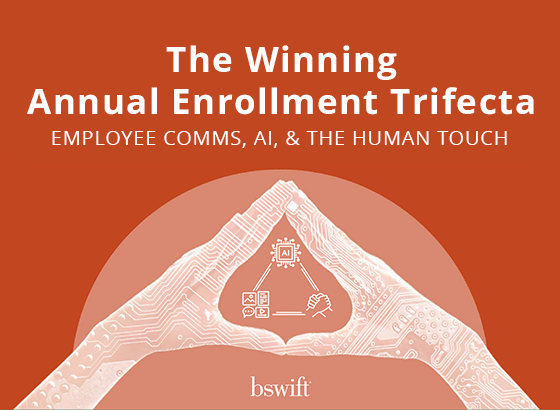
Our annual enrollment infographic unlocks the power of effective communication, AI, and human expertise for a seamless benefits experience.


Master annual enrollment with our checklist. From HR tech to communication planning, streamline your HR process and improve your employee benefits rollout.

Learn how holistic health trends in employee wellbeing programs like value-based care, whole person care, mental health.

Cut through the hype. From Mindful AI to people analytics, these 4 trends in AI for HR boost employee engagement and attract top talent.

Unlock AI’s potential in HR with bswift: Automate tasks, enhance decision-making, and focus on strategic goals. Discover AI’s role in recruitment, onboarding, and more
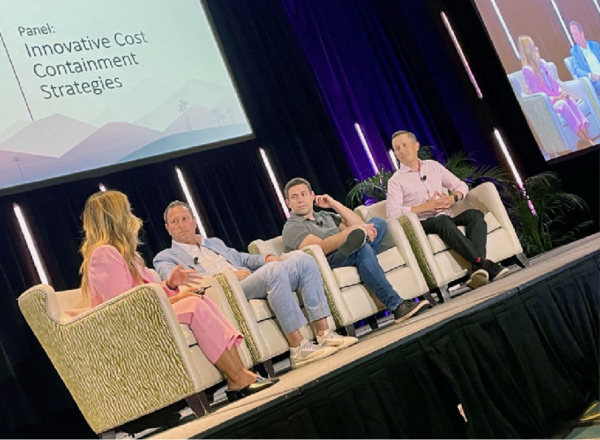
Rising healthcare costs got your HR team down? Discover 4 data-driven cost-containment strategies from bswift's IX to reduce healthcare spending & improve wellbeing.

bswift Engagement Solutions wins 2 Gold Hermes Awards for creative employee benefits communication. Learn more about our award-winning work!
Empower your employees with bswift's Emma, an AI-powered benefits assistant. Personalized recommendations, plan comparisons and more.

Simplify benefits administration and empower HR with tools to streamline enrollment, optimize benefits use, and free HR for strategic work.

Effective employee communication is crucial for HR. Learn best practices to improve benefits utilization and employee engagement.

Benefits enrollment best practices for HR. Improve employee communications strategies, analyze benefits utilization and enhance benefits portfolios.

February is American Heart Month – the perfect time to focus on workplace wellness and heart health through personalized digital tools and connected capabilities.

Let's look at the future of HR, from AI and automation to cost containment, tailored well-being initiatives, and adapting to remote work.

Boost employee benefits engagement with proven HR strategies like clear communication, feedback loops, and AI chatbots to empower employees

bswift Elevate is reimagining the employee well-being journey and simplifying the employee experience with hyper-personalized messaging to drive deeper engagement in employer wellbeing programs.

A smart way to boost employee engagement is to create a total compensation statement that details the value of their salary, benefits and other rewards.
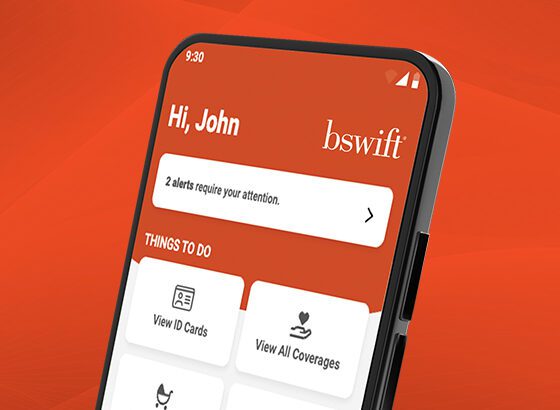
The bswift Mobile App offers your employees seamless access to their benefits. Download the app now via the App Store or Google Play Store.

Make annual enrollment frictionless and empowering, These tips will help you optimize the employee experience and drive talent retention.

Explore the core connection between employee benefits, employee wellbeing, and business success. Get a roadmap for reviewing your organization's current offerings to ensure they're relevant, accessible and effectively supporting workforce health and productivity.
bswift's Idea Exchange 2023 Conference brings you insights on employee benefits engagement and benefits administration. Access session videos and more. Perfect for any HR professional looking to stay up-to-date.

Meet Emma, the AI HR assistant who resolves benefits questions, provides enrollment guidance, and improves the employee experience.

Great employee benefits communication is crucial for employee satisfaction. Get tips for effective benefits communications that engage all stakeholders, using a multi-channel approach, incorporating empathy, focusing on timing, highlighting total rewards, and broadening the conversation on employee wellbeing.
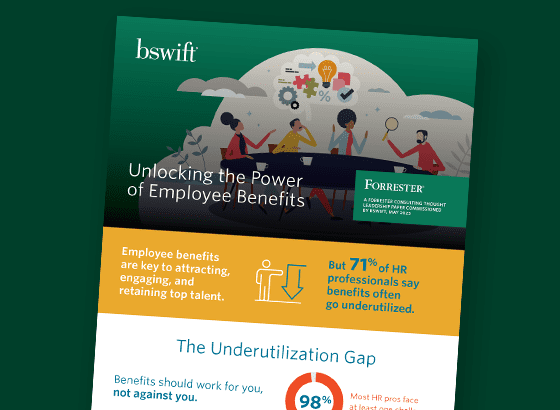
Employee benefits are key to attracting, engaging and retaining top talent. Read this infographic to learn more on the underutilization gap

Improve retention, engagement, wellbeing and productivity with an effective employee benefits utilization strategy. Boost benefits engagement with these tips.

Improve engagement and retention with effective employee benefits utilization. Learn common challenges, solutions, and the importance of prioritizing employee wellbeing.

Discover how HR pros can improve employee benefits engagement with insights from Forrester Research. Boost morale, productivity and retention, and cut healthcare costs. See the survey results and actionable strategies now.

Learn which employee benefits matter most to employees, and how these top employee benefits boost satisfaction, retention, and recruitment. A must-read for HR professionals.

bswift experts answer CHROs' questions about using AI to improve HR. Learn how to avoid pitfalls, partner with CTOs, and create a better employee experience.

Let's look at the benefits and the risks of AI in HR. From data privacy to legal liability, CHROs and CTOs can partner to safely implement AI for business.

Unlock the full potential of your employee benefits communication. Benefits U helps you save time and effort and boost employee engagement.

Learn how to reduce healthcare costs and improve employee satisfaction with a culture of health in the workplace. Follow these 6 easy steps.

How you can make the most of this celebration by incorporating employee benefits into your diversity, equity, and inclusion strategy.

With the dust settling on annual enrollment, it's time to look back and learn. Here are a few simple questions you and your HR team can ask.

In 2023, technology will continue to play a major role in how we adapt. Here are the top five HR trends we’re watching in 2023.
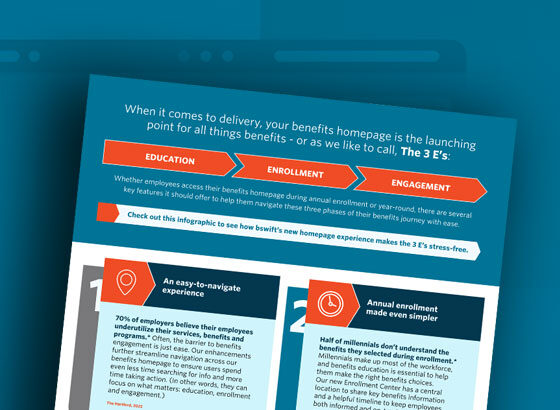
Your benefits homepage is the launching point for all things benefits, check out this infographic to see how bswift's new home page experience makes the 3 E's stress free.

Struggling to navigate the Great Resignation? Here are a few ways to improve and develop a more employee-centric-culture.