
Articles
December 09, 2025

Managing HR for a hospital is not your typical 9-to-5 job. Hospital HR professionals operate in a 24/7 environment where the stakes are sometimes quite literally life and death. On top of that, your workforce is a dizzying and complicated mix of clinicians, administrators and support staff.
While your friends in other industries are talking about unlimited PTO and remote work arrangements, you’re trying to keep your best nurses from burning out and leaving for a travel assignment that pays twice as much. So, it’s more than just a completely different ball game. It’s a different sport altogether.
And those unique challenges call for a unique benefits administration solution.
To begin with, hospital system employees have different needs and face pressures unlike those in any other industry. Because of this, it’s not just about offering good medical and dental coverage—it’s about building a package that can meet the demands of a healthcare career.
Basically, your employees just aren’t like those in other industries, and neither are their needs. That is why you need a benefits administration partner who specializes in this complexity.
You can make benefits easier for your healthcare workforce to understand and engage with by using technology that educates and guides them to the choices that are right for them. After a rough 12-hour shift, the last thing healthcare workers want to do is navigate a confusing portal or try to decipher complex benefits documents. That’s why personalized decision support makes a huge difference.
Take MaineHealth, Northern New England’s largest health system. They offered competitive benefits, but adoption rates for voluntary plans like hospital indemnity and critical illness were stubbornly low. The HR team knew their people would benefit from this extra layer of financial protection, but it was complicated to explain.
They didn’t want to just cross their fingers and hope employees would fumble through it. So, they worked with bswift to integrate an AI-powered tool called Emma™ directly into their enrollment process. Emma acts as a personal benefits guide, asking simple questions and offering tailored recommendations in plain English. In fact, she can provide those recommendations in more than 150 other languages. The impact was immediate.
More importantly, the number of employees enrolling in all three voluntary benefits shot up by a staggering 560%. The full details are available in our MaineHealth case study.
By making benefits easier to understand, MaineHealth didn’t just improve enrollment numbers, they gave their workforce greater financial security and peace of mind.
For healthcare HR leaders, the most effective way to control benefits costs is by eliminating administrative waste—not reducing benefits.
The truth is, most unnecessary spending doesn’t come from the benefits themselves but from clunky, error-prone admin systems not built with the complexity of a hospital workforce in mind. For example, things like payroll mistakes and premiums for ineligible dependents can quietly chip away at budgets. But by using a benefits platform with smart automation and built-in accuracy checks, healthcare systems can eliminate these costly errors.
For one regional health system, partnering with bswift was the fresh approach they needed. With more than 16,000 employees counting on them, they found themselves stuck in outdated, manual processes. Because of this, they were losing money in ways they couldn’t quite see.
Together, we launched numerous benefits admin and HR services, including:
As a result, their payoff was huge:
The takeaway is that you don’t have to choose between cost control and a great employee experience. With the right partner and smarter tools, healthcare systems can definitely do both. Read the full case study to see how bswift helped strengthen mission, culture and cost-efficiency through smarter benefits administration.
Essentially, a benefits administration solution built for hospitals should include complex workforce management, regulatory compliance automation, seamless payroll integration, mobile-friendly employee self-service and advanced analytics.
These stories are just a small window into what’s possible with a benefits administration platform built for the complexity of hospitals.
In fact, with 106 health system clients and a 98% client retention rate, we know what makes a successful hospital benefits administration solution. It’s about more than just software. It’s about a deep understanding of what hospital HR needs to be successful.
In the end, what you need is confidence. You need confidence that your benefits are a strategic asset, not an administrative burden. You need confidence that your people feel supported and valued. And most importantly, you need confidence that you have a partner who is just as committed to your mission as you are.
Hospitals are different. Your challenges are unique,.and your benefits partner should be, too.
How does bswift handle the complex eligibility rules for part-time and per-diem hospital staff?
Our platform is specifically designed for complex workforces. In fact, we configure flexible eligibility rules that can automatically manage benefits for variable-hour employees, different shifts, and on-call staff, ensuring accuracy without manual intervention.
Can bswift integrate with our existing HRIS and payroll vendors?
Yes. Seamless integration is one of our core strengths. bswift’s API gateway and established connections with major HRIS and payroll systems ensure that data for deductions, eligibility, and employee changes flows accurately and efficiently.
What kind of support does bswift offer for employee benefits education?
We provide a suite of communication and decision-support tools, including our AI-powered guide, Emma. These tools help simplify complex healthcare plans, offer personalized recommendations, and guide employees through enrollment, boosting their confidence and satisfaction.
How does bswift ensure HIPAA compliance and data security?
Our data systems and processes are built to exceed industry standards for security and compliance. Because of that, we can provide built-in tools for HIPAA, ACA and COBRA administration, including automated reporting and secure data handling, to protect your organization and your employees.

If your benefits budget feels like it’s being quietly squeezed by a very polite boa constrictor, you aren’t alone. What was once a clinical breakthrough for diabetes has evolved into a complex financial and governance challenge for 2026.

See how bswift helped HR and employees navigate open enrollment 2025 with ease, boosting employee engagement along the way.

HRIS vs benefits platform? There are hidden costs with certain benefits software. Get the guide to choosing the right HR tech partner.

When we started building what would become Emma Intelligence, our team kept circling one question: How do we make benefits feel less like doing taxes and more like talking to someone who actually gets it?

It’s open enrollment season — HR’s annual enrollment Super Bowl, where strategy meets sheer endurance.

AI is everywhere in HR right now. Every conference, every panel, every software demo — it’s the headline act. And if you’re in charge of benefits, you’re already feeling the squeeze.

Personalization isn’t a perk to Millennials and Gen Z—it’s the default setting. They expect their benefits to work like all digital experiences: seamless, intuitive, and a step ahead of their needs.
For HR, annual enrollment isn’t just another task—it’s a high-stakes, strategic opportunity to boost employee engagement, satisfaction and retention.

Prepare for enrollment season with our open enrollment checklist! Discover tips, strategies, and a comprehensive checklist to streamline your planning and execution.

On July 4, 2025, President Trump signed the One Big Beautiful Bill Act (OBBBA) into law.

Download this HR Buyer’s Guide to benefits administration solutions. Learn how to compare vendors, evaluate features, and build a business case with real ROI.

Discover four strategies HR leaders can use rebuild clarity, foster connections, create meaningful growth opportunities and boost employee engagement.
Hear how bswift's Service Center blends HR tech and empathy to transform employee benefits support—driving a 95% satisfaction rate.
Relive the Idea Exchange 2025 highlights! Discover insights, standout sessions, and a recap of what made IX so incrediblen for HR pros this year.
Dive into some of the top sessions from Idea Exchange 2025—now available to watch anytime.

Whether it’s clunky manual tasks, confused employees, low engagement, or compliance risks, your current system is frustrating and feels like it’s holding you back.

Employee engagement is not doing great. It’s at a 10-year low, with only 31% of U.S. employees reporting they feel engaged at work, according to Gallup. Disengaged teams don’t drive innovation, collaboration, or results for organizations.

Discover four strategies HR leaders can use rebuild clarity, foster connections, create meaningful growth opportunities and boost employee engagement.

Discover the HR trends shaping 2025, from skyrocketing healthcare costs to smarter benefits strategies. Learn how to stay ahead and support your team.

Stress-free annual enrollment starts with bswift. Explore our infographic for HR tech, stellar service, and employee satisfaction at light speed!

Support employee health and reduce costs with effective diabetes management programs that promote workplace wellness and enhance productivity.

Here's how strong company culture, driven by core values, improves employee engagement and business success. Learn how to strengthen culture.
Our annual enrollment infographic unlocks the power of effective communication, AI, and human expertise for a seamless benefits experience.

AI is transforming benefits administration. Discover how bswift's Mindful AI® enhances human abilities, improving efficiency, accuracy, and user satisfaction.

Master annual enrollment with our checklist. From HR tech to communication planning, streamline your HR process and improve your employee benefits rollout.

Learn how holistic health trends in employee wellbeing programs like value-based care, whole person care, mental health can boost ROI.

Cut through the hype. From Mindful AI to people analytics, these 4 trends in AI for HR boost employee engagement and attract top talent.
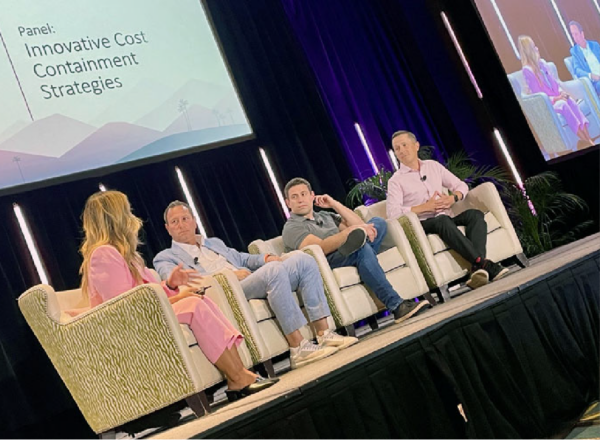
Rising healthcare costs got your HR team down? Discover 4 data-driven cost-containment strategies from bswift's IX to reduce healthcare spending & improve wellbeing.
Leverage AI for HR with bswift's Mindful AI® approach. See how AI enhances human expertise, recruiting, onboarding, engagement and compliance.

bswift Engagement Solutions wins 2 Gold Hermes Awards for creative employee benefits communication. Learn more about our award-winning work!
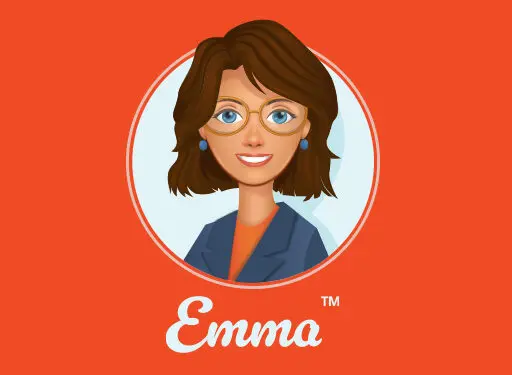
Empower your employees with bswift's Emma, an AI-powered benefits assistant. Personalized recommendations, plan comparisons and more.
Simplify benefits administration and empower HR with tools to streamline enrollment, optimize benefits use, and free HR for strategic work.

Effective employee communication is crucial for HR. Learn best practices to improve benefits utilization and employee engagement.
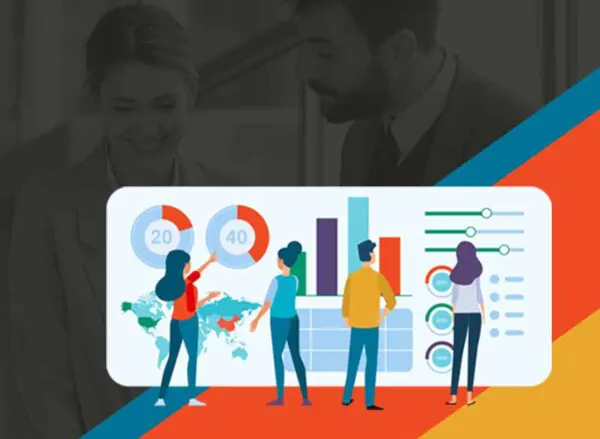
Benefits enrollment best practices for HR. Improve employee communications strategies, analyze benefits utilization and enhance benefits portfolios.

February is American Heart Month – the perfect time to focus on workplace wellness and heart health through personalized digital tools and connected capabilities.

Let's look at the future of HR, from AI and automation to cost containment, tailored well-being initiatives, and adapting to remote work.

Boost employee benefits engagement with proven HR strategies like clear communication, feedback loops, and AI chatbots to empower employees

bswift Elevate is reimagining the employee well-being journey and simplifying the employee experience with hyper-personalized messaging to drive deeper engagement in employer wellbeing programs.

A smart way to boost employee engagement is to create a total compensation statement that details the value of their salary, benefits and other rewards.
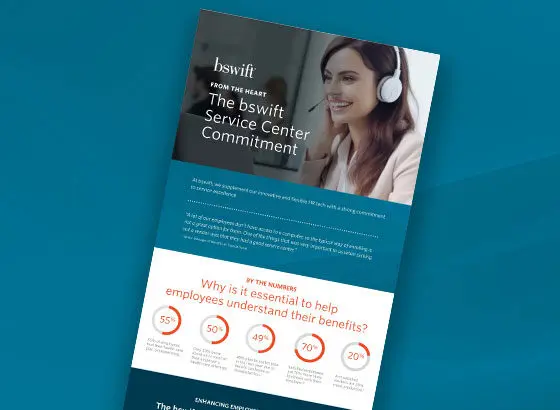
At bswift, we supplement our innovative and flexible HR tech with a strong commitment to service excellence.
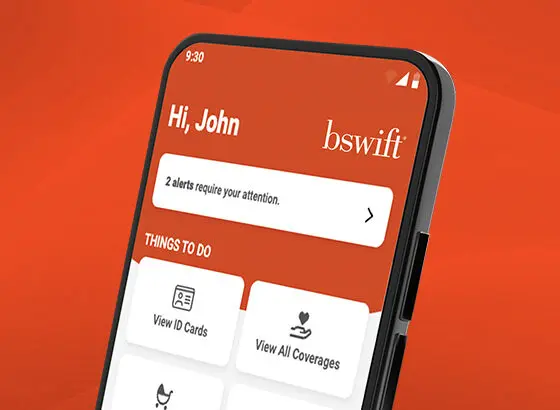
The bswift Mobile App offers your employees seamless access to their benefits. Download the app now via the App Store or Google Play Store.

Make annual enrollment frictionless and empowering, These tips will help you optimize the employee experience and drive talent retention.

Explore the core connection between employee benefits, employee wellbeing, and business success. Get a roadmap for reviewing your organization's current offerings to ensure they're relevant, accessible and effectively supporting workforce health and productivity.
bswift's Idea Exchange 2023 Conference brings you insights on employee benefits engagement and benefits administration. Access session videos and more. Perfect for any HR professional looking to stay up-to-date.
Meet Emma, the AI HR assistant who resolves benefits questions, provides enrollment guidance, and improves the employee experience.

Great employee benefits communication is crucial for employee satisfaction. Get tips for effective benefits communications that engage all stakeholders, using a multi-channel approach, incorporating empathy, focusing on timing, highlighting total rewards, and broadening the conversation on employee wellbeing.
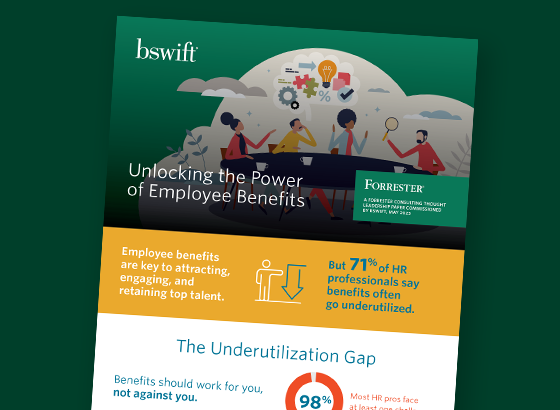
Employee benefits are key to attracting, engaging and retaining top talent. Read this infographic to learn more on the underutilization gap

Improve retention, engagement, wellbeing and productivity with an effective employee benefits utilization strategy. Boost benefits engagement with these tips.

Improve engagement and retention with effective employee benefits utilization. Learn common challenges, solutions, and the importance of prioritizing employee wellbeing.

Discover how HR pros can improve employee benefits engagement with insights from Forrester Research. Boost morale, productivity and retention, and cut healthcare costs. See the survey results and actionable strategies now.

Learn which employee benefits matter most to employees, and how these top employee benefits boost satisfaction, retention, and recruitment. A must-read for HR professionals.

bswift experts answer CHROs' questions about using AI to improve HR. Learn how to avoid pitfalls, partner with CTOs, and create a better employee experience.

Let's look at the benefits and the risks of AI in HR. From data privacy to legal liability, CHROs and CTOs can partner to safely implement AI for business.

Unlock the full potential of your employee benefits communication. Benefits U helps you save time and effort and boost employee engagement.

Learn how to reduce healthcare costs and improve employee satisfaction with a culture of health in the workplace. Follow these 6 easy steps.

How you can make the most of this celebration by incorporating employee benefits into your diversity, equity, and inclusion strategy.

With the dust settling on annual enrollment, it's time to look back and learn. Here are a few simple questions you and your HR team can ask.

In 2023, technology will continue to play a major role in how we adapt. Here are the top five HR trends we’re watching in 2023.
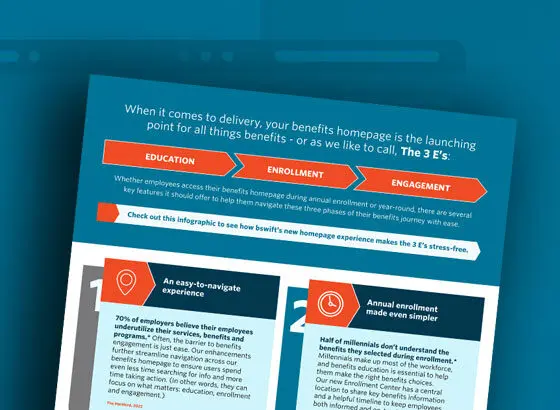
Your benefits homepage is the launching point for all things benefits, check out this infographic to see how bswift's new home page experience makes the 3 E's stress free.

Struggling to navigate the Great Resignation? Here are a few ways to improve and develop a more employee-centric-culture.