
White Paper
January 21, 2026

There’s a reason “penny wise and pound foolish” has survived centuries of business wisdom. What looks like a cost-saving move up front can end up being the most expensive decision you make. And nowhere is this truer than in how employers approach benefits administration.
Right now, many HR leaders are hearing the same pitch from their HCM software vendors: “Why not consolidate? Pay us a little more, and we’ll handle your benefits enrollment and administration too.”
At first glance, the offer sounds irresistible. One point of accountability. One system for everything. One invoice to manage. Who wouldn’t want that?
But as with most too-good-to-be-true platforms, the real costs don’t show up until later. And when it comes to something as high-stakes as employee benefits—where compliance, employee health, and financial security are all on the line—those hidden costs can be enormous.
This isn’t about defending a business model. It’s about recognizing the risks of treating benefits as an afterthought, and why dedicated expertise is the safer, smarter investment in the long run.
HCM vendors have perfected the art of bundling. Payroll, time tracking, recruiting—add one more line item to your existing contract, and you feel like you’re getting a deal.
But benefits administration isn’t payroll. It isn’t a “nice to have.”
It’s one of the largest line items in your budget. It’s a heavily regulated space. It’s also a deeply personal employee experience—touching health, family, and money.
When benefits get reduced to an HCM system’s lowest-priority feature, you’re inviting complexity, compliance exposure, and employee dissatisfaction into your organization.
Consider the reality for most employers. You’re not administering a single, uniform plan for a homogenous workforce. You’ve got union contracts, salaried and hourly groups, retirees, grandfathered benefits, multiple carriers, multiple generations, and evolving legislation.
An HCM vendor’s benefits module wasn’t built with that level of complexity in mind. Their “templates” force you to adapt your programs to fit their system. Any deviation—a new vendor integration, a carve-out group, or a compliance nuance—requires IT workarounds, consultants, possible fees, or months of waiting for updates.
Contrast that with a dedicated benefits administrator. This is their core business. The technology, the processes, and the people are built around benefits from the ground up. Complex eligibility? Multi-tiered retirees? Union rules? They’ve seen it all, and they’ve solved it before.
The difference isn’t abstract. It’s the difference between a system that bends to your strategy versus a system that forces your strategy to bend.
On paper, the bundled price from your HCM provider looks cheaper. But here’s what those numbers don’t show you:
In fact, when you tally these categories, the “cheaper” HCM option can cost triple what outsourcing to a dedicated benefits administrator does. One recent analysis showed insourcing benefits administration drove annual costs to nearly $700,000 versus $215,000 with a specialized vendor.
Over three years, that added up to more than $1.2 million in extra spend—all for a worse employee experience.
It’s easy to frame this conversation as pure dollars and cents. But let’s not forget why you’re offering benefits in the first place.
Benefits are a massive investment precisely because they matter so much to employees. They’re about keeping families healthy, protecting financial security, and making sure employees feel supported at work.
When employees can’t navigate a clunky HCM interface, or when they can’t get straight answers from a generic call center, it undermines that entire investment. Confused employees make poor benefits choices. Poor choices lead to higher claims, lower satisfaction, and increased turnover.
Specialized enrollment tools—chat support, guided plan recommendations, mobile apps with ID cards—don’t just make benefits easier. They make them effective. Employees end up in plans that fit their needs, saving both them and the employer money.
That’s not a “feature.” That’s the ROI of doing benefits administration right.
Benefits aren’t static. Each year brings new carriers, new plan designs, and new regulatory requirements.
In a consolidated HCM model, every change becomes a project—complete with requirements meetings, coding, testing, and additional fees. Small changes can take months. Larger changes risk derailing open enrollment altogether.
In a specialized model, change is the norm. The systems and staff are built for rapid reconfiguration, clean testing, and smooth launches. That agility isn’t just nice to have. It’s the difference between keeping pace with your strategy and being shackled by your system.
The benefits landscape is about to change faster than it ever has. Artificial intelligence isn’t a side show. It’s reshaping how employees evaluate plans, get guidance, and access care.
If you tether your benefits to an HCM platform, you’re locking yourself into yesterday’s priorities. Their R&D dollars go to payroll and timekeeping. Benefits modules get whatever’s left over—occasional bolt-on “upgrades” that patch old tech and introduce more friction than they remove.
That’s not just inconvenience. It’s exposure. Employees will expect intelligent, personalized guidance. Competitors will offer it. If your system can’t deliver, your workforce notices—and they leave.
Meanwhile, compliance rules will only get more complex. AI can flag risks and prevent errors before they become fines. If your benefits stack isn’t built for that, you’re carrying the liability.
The choice is stark: Embrace a partner that is leading the AI revolution in benefits—or get stuck with a legacy module that leaves you behind, paying more for outdated tools that keep you locked out of the next evolution of benefits.
So, should you consolidate with your HCM vendor just because it looks simpler and cheaper up front?
If benefits were a side-line, maybe. But benefits are not a side-line. They’re one of your largest investments, a critical compliance obligation, and a deeply personal employee experience.
That’s why expertise matters. It’s why what looks like savings now can easily spiral into higher costs, greater risk, and more employee frustration later.
The real question isn’t: “how do I consolidate vendors?” The real question is: “How do I maximize the return on my benefits investment while minimizing risk?”
The answer is to choose expertise. Choose the partner whose entire business is built around benefits administration.
Choose the path that saves you in the end.
* All of the statistics mentioned are from our internal source in 2025.

Personalization delivered at scale can support proactive resolution—but its real power lies in shaping smarter decisions, helping people access care earlier, and reducing avoidable healthcare spend.

HRIS platforms often position benefits administration as an easy add-on: one system, one contract, one vendor.

If your benefits budget feels like it’s being quietly squeezed by a very polite boa constrictor, you aren’t alone. What was once a clinical breakthrough for diabetes has evolved into a complex financial and governance challenge for 2026.

See how bswift helped HR and employees navigate open enrollment 2025 with ease, boosting employee engagement along the way.

Managing HR for a hospital is not your typical 9-to-5 job. Hospital HR professionals operate in a 24/7 environment where the stakes are sometimes quite literally life and death, and your workforce is a dizzying mix of clinicians, administrators and support staff.

HRIS vs benefits platform? There are hidden costs with certain benefits software. Get the guide to choosing the right HR tech partner.

When we started building what would become Emma Intelligence, our team kept circling one question: How do we make benefits feel less like doing taxes and more like talking to someone who actually gets it?

It’s open enrollment season — HR’s annual enrollment Super Bowl, where strategy meets sheer endurance.

AI is everywhere in HR right now. Every conference, every panel, every software demo — it’s the headline act. And if you’re in charge of benefits, you’re already feeling the squeeze.

Personalization isn’t a perk to Millennials and Gen Z—it’s the default setting. They expect their benefits to work like all digital experiences: seamless, intuitive, and a step ahead of their needs.
For HR, annual enrollment isn’t just another task—it’s a high-stakes, strategic opportunity to boost employee engagement, satisfaction and retention.

Prepare for enrollment season with our open enrollment checklist! Discover tips, strategies, and a comprehensive checklist to streamline your planning and execution.

On July 4, 2025, President Trump signed the One Big Beautiful Bill Act (OBBBA) into law.

Download this HR Buyer’s Guide to benefits administration solutions. Learn how to compare vendors, evaluate features, and build a business case with real ROI.

Discover four strategies HR leaders can use rebuild clarity, foster connections, create meaningful growth opportunities and boost employee engagement.

Hear how bswift's Service Center blends HR tech and empathy to transform employee benefits support—driving a 95% satisfaction rate.
Relive the Idea Exchange 2025 highlights! Discover insights, standout sessions, and a recap of what made IX so incrediblen for HR pros this year.
Dive into some of the top sessions from Idea Exchange 2025—now available to watch anytime.

Whether it’s clunky manual tasks, confused employees, low engagement, or compliance risks, your current system is frustrating and feels like it’s holding you back.

Employee engagement is not doing great. It’s at a 10-year low, with only 31% of U.S. employees reporting they feel engaged at work, according to Gallup. Disengaged teams don’t drive innovation, collaboration, or results for organizations.

Discover four strategies HR leaders can use rebuild clarity, foster connections, create meaningful growth opportunities and boost employee engagement.

Discover the HR trends shaping 2025, from skyrocketing healthcare costs to smarter benefits strategies. Learn how to stay ahead and support your team.

Stress-free annual enrollment starts with bswift. Explore our infographic for HR tech, stellar service, and employee satisfaction at light speed!

Support employee health and reduce costs with effective diabetes management programs that promote workplace wellness and enhance productivity.

Here's how strong company culture, driven by core values, improves employee engagement and business success. Learn how to strengthen culture.
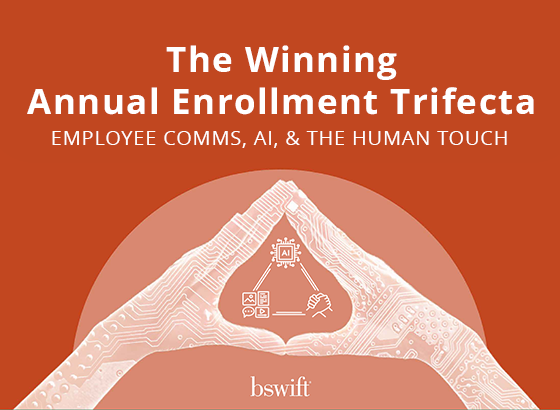
Our annual enrollment infographic unlocks the power of effective communication, AI, and human expertise for a seamless benefits experience.

AI is transforming benefits administration. Discover how bswift's Mindful AI® enhances human abilities, improving efficiency, accuracy, and user satisfaction.

Master annual enrollment with our checklist. From HR tech to communication planning, streamline your HR process and improve your employee benefits rollout.

Learn how holistic health trends in employee wellbeing programs like value-based care, whole person care, mental health can boost ROI.

Cut through the hype. From Mindful AI to people analytics, these 4 trends in AI for HR boost employee engagement and attract top talent.
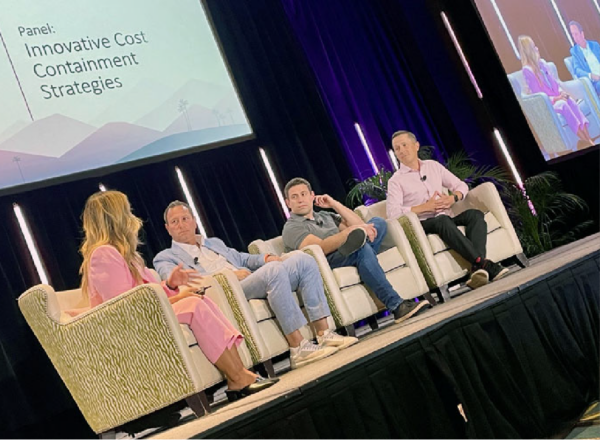
Rising healthcare costs got your HR team down? Discover 4 data-driven cost-containment strategies from bswift's IX to reduce healthcare spending & improve wellbeing.
Leverage AI for HR with bswift's Mindful AI® approach. See how AI enhances human expertise, recruiting, onboarding, engagement and compliance.

bswift Engagement Solutions wins 2 Gold Hermes Awards for creative employee benefits communication. Learn more about our award-winning work!
Empower your employees with bswift's Emma, an AI-powered benefits assistant. Personalized recommendations, plan comparisons and more.
Simplify benefits administration and empower HR with tools to streamline enrollment, optimize benefits use, and free HR for strategic work.

Effective employee communication is crucial for HR. Learn best practices to improve benefits utilization and employee engagement.

Benefits enrollment best practices for HR. Improve employee communications strategies, analyze benefits utilization and enhance benefits portfolios.

February is American Heart Month – the perfect time to focus on workplace wellness and heart health through personalized digital tools and connected capabilities.

Let's look at the future of HR, from AI and automation to cost containment, tailored well-being initiatives, and adapting to remote work.

Boost employee benefits engagement with proven HR strategies like clear communication, feedback loops, and AI chatbots to empower employees

bswift Elevate is reimagining the employee well-being journey and simplifying the employee experience with hyper-personalized messaging to drive deeper engagement in employer wellbeing programs.

A smart way to boost employee engagement is to create a total compensation statement that details the value of their salary, benefits and other rewards.
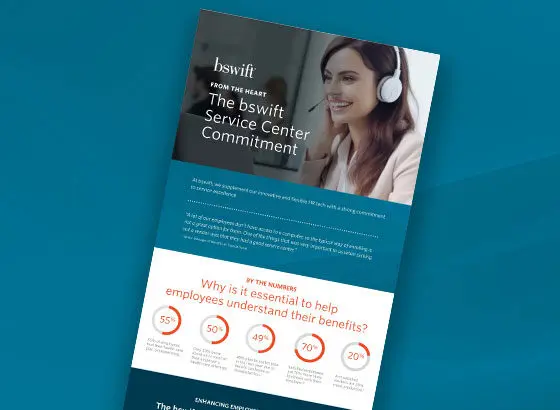
At bswift, we supplement our innovative and flexible HR tech with a strong commitment to service excellence.
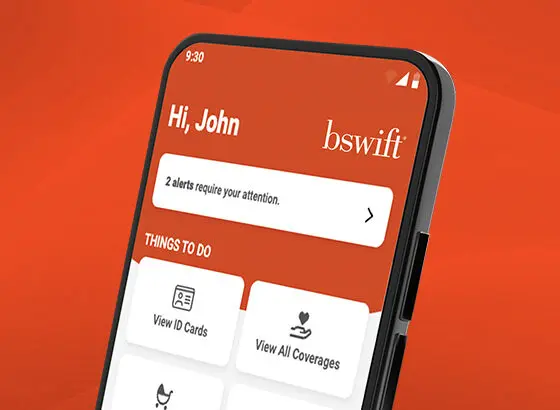
The bswift Mobile App offers your employees seamless access to their benefits. Download the app now via the App Store or Google Play Store.

Make annual enrollment frictionless and empowering, These tips will help you optimize the employee experience and drive talent retention.

Explore the core connection between employee benefits, employee wellbeing, and business success. Get a roadmap for reviewing your organization's current offerings to ensure they're relevant, accessible and effectively supporting workforce health and productivity.
bswift's Idea Exchange 2023 Conference brings you insights on employee benefits engagement and benefits administration. Access session videos and more. Perfect for any HR professional looking to stay up-to-date.

Meet Emma, the AI HR assistant who resolves benefits questions, provides enrollment guidance, and improves the employee experience.

Great employee benefits communication is crucial for employee satisfaction. Get tips for effective benefits communications that engage all stakeholders, using a multi-channel approach, incorporating empathy, focusing on timing, highlighting total rewards, and broadening the conversation on employee wellbeing.
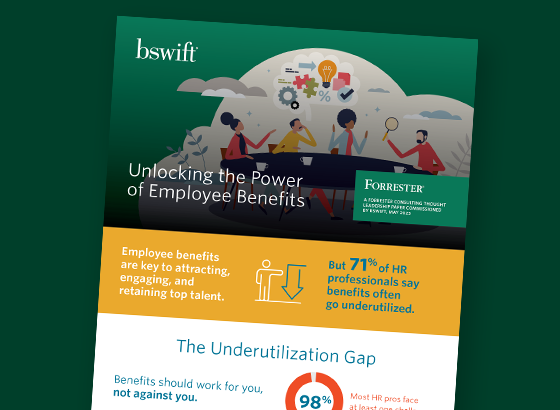
Employee benefits are key to attracting, engaging and retaining top talent. Read this infographic to learn more on the underutilization gap

Improve retention, engagement, wellbeing and productivity with an effective employee benefits utilization strategy. Boost benefits engagement with these tips.

Improve engagement and retention with effective employee benefits utilization. Learn common challenges, solutions, and the importance of prioritizing employee wellbeing.

Discover how HR pros can improve employee benefits engagement with insights from Forrester Research. Boost morale, productivity and retention, and cut healthcare costs. See the survey results and actionable strategies now.

Learn which employee benefits matter most to employees, and how these top employee benefits boost satisfaction, retention, and recruitment. A must-read for HR professionals.

bswift experts answer CHROs' questions about using AI to improve HR. Learn how to avoid pitfalls, partner with CTOs, and create a better employee experience.

Let's look at the benefits and the risks of AI in HR. From data privacy to legal liability, CHROs and CTOs can partner to safely implement AI for business.

Unlock the full potential of your employee benefits communication. Benefits U helps you save time and effort and boost employee engagement.

Learn how to reduce healthcare costs and improve employee satisfaction with a culture of health in the workplace. Follow these 6 easy steps.

How you can make the most of this celebration by incorporating employee benefits into your diversity, equity, and inclusion strategy.

With the dust settling on annual enrollment, it's time to look back and learn. Here are a few simple questions you and your HR team can ask.

In 2023, technology will continue to play a major role in how we adapt. Here are the top five HR trends we’re watching in 2023.
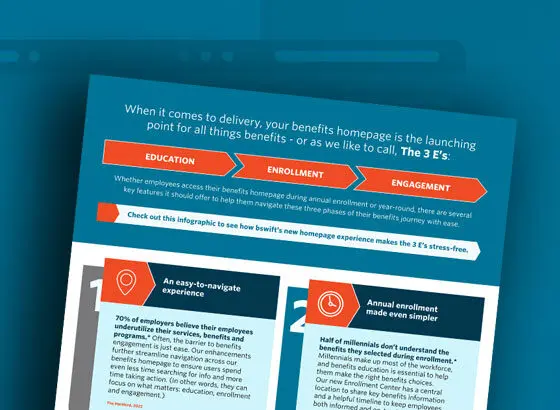
Your benefits homepage is the launching point for all things benefits, check out this infographic to see how bswift's new home page experience makes the 3 E's stress free.

Struggling to navigate the Great Resignation? Here are a few ways to improve and develop a more employee-centric-culture.